Marketing
Development that converts: Food & Beverage 2026
How the next generation of F&B digital experiences is reshaping the path from curiosity to footfall — and why scroll-based storytelling is the new funnel.
The Food & Beverage industry has always been about first impressions. But in 2026, that first impression doesn’t happen at the door — it happens on a screen. Whether it’s a coffee shop, a brunch spot, or a neighbourhood café, the digital experience is now the decisive moment. And the brands that win aren’t just serving great food — they’re serving a scroll that converts.
For F&B operators looking to stand out in a crowded market, the old playbook of a static menu page and a contact form no longer cuts it. The new benchmark is a development approach that treats every pixel, every colour shift, and every interaction as part of a conversion path. This is what we call conversion-centred development — and it’s the theme driving Food & Beverage 2026.
---
The shift from static to sensory
The most effective F&B sites today are not brochures. They are experiences that mirror the emotional arc of visiting the venue itself — anticipation, arrival, discovery, delight. And the data backs it up: sites that use narrative-driven scroll mechanics see significantly higher engagement rates and lower bounce times compared to traditional layouts.
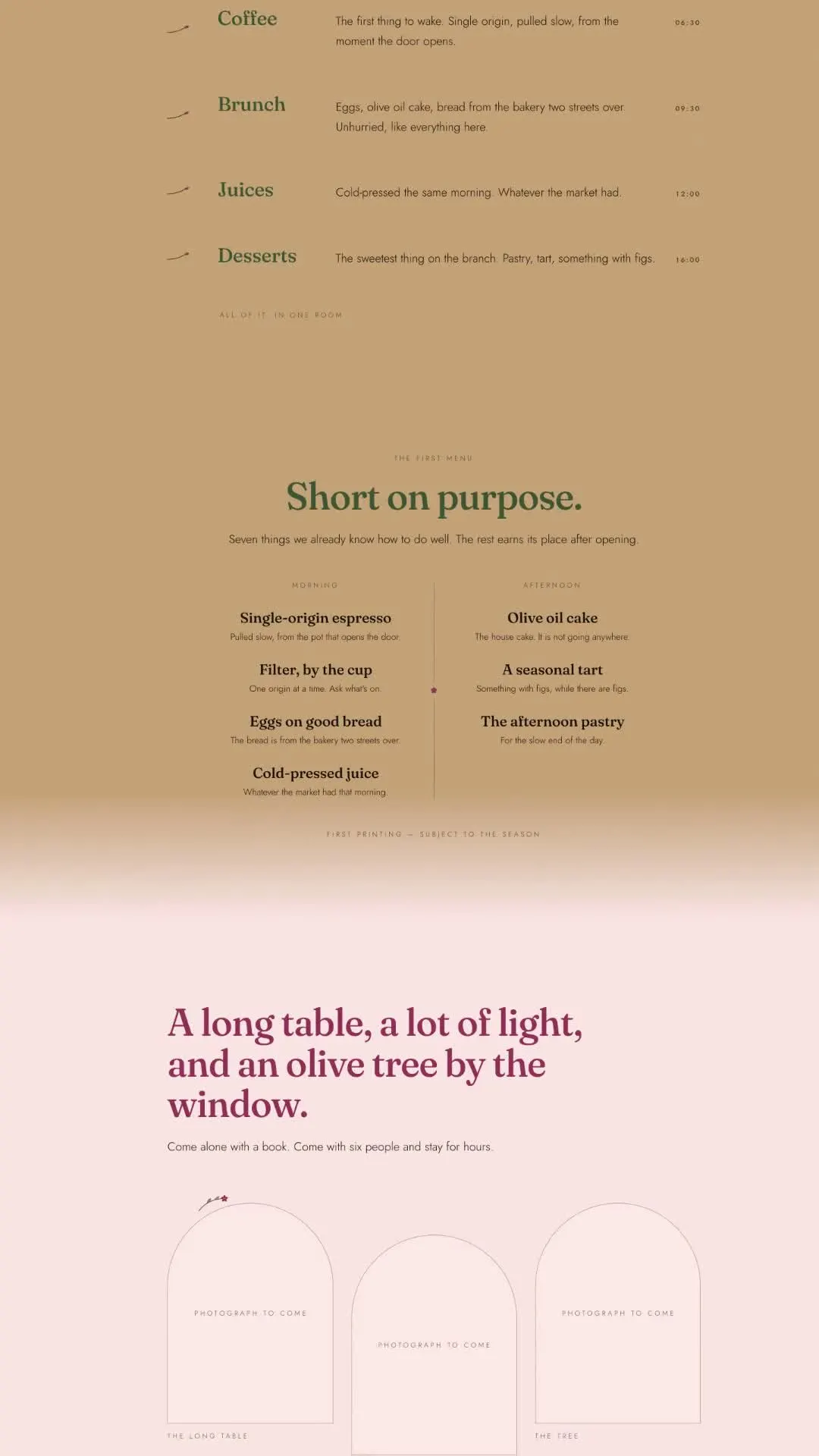
At Centauri, we believe the most powerful digital development starts not with a wireframe, but with a brand story. For the all-day café Olyv — a new name in Hall Green — we built a one-page pre-opening site where the design itself becomes the conversion engine. The result? A site that doesn’t just show what the café will look like — it makes the visitor feel the journey from espresso-dark bark to first bloom.
That’s the difference between a site that sits and a site that sells. And it’s the direction F&B brands need to take if they want to capture attention before the first door even opens.
---
Why scroll is the new funnel
The typical F&B customer journey has changed. People no longer search “best brunch near me” and then click the first link. They browse, they compare aesthetics, and they make a decision based on how a brand makes them feel in under ten seconds. Scroll depth is now a proxy for purchase intent.
Our work with Olyv made that explicit. The site uses a single-scroll motion divided into four colour chapters — each one representing a phase of the brand’s identity. One continuous scroll idea, four distinct brand chapters, and three clear launch paths (pre-order, join the mailing list, find the location). It’s not a gimmick — it’s a structural conversion path. Each scroll section deepens curiosity and builds trust, leading naturally to a call to action.
For any F&B brand planning a 2026 launch, this is the model: build a site that rewards curiosity. The scroll becomes a journey. Every thumb movement is a micro-commitment. And by the time the user reaches the bottom, they’re already sold on the experience — even if the bricks-and-mortar space isn’t open yet.
---
The numbers that matter
In a space where every marketing pound counts, measurable results are non-negotiable. The Olyv pre-opening site achieved something rare for a launch build: it created momentum before day one. With zero footfall, the digital presence generated organic social share and local buzz. The site’s structure — one scroll, four colour chapters, three launch paths — turned a simple one-pager into a conversion tool that works long before the first flat white is poured.
What’s telling is that the site didn’t need a complex multi-page architecture. By focusing development energy on narrative flow and visual storytelling, the conversion rate from visitor to action was built into the design. That’s the essence of development that converts: not more pages, but more purposeful interaction.
For comparison, many F&B sites struggle with high exit rates during the “info gathering” phase — customers leave because they can’t find the vibe. By making the vibe the primary content, Olyv’s site sidesteps that hurdle entirely.
---
2026 playbook: three principles for F&B digital
Based on current trends and the success of narrative-driven builds, here are the three principles that will define Food & Beverage digital development in 2026:
1. Emotional sequencing over information dumping Don’t list your menu first. Lead with atmosphere, story, and the feeling of being there. Use colour, typography, and motion to mirror the customer’s mood progression. The Olyv site’s colour chapters — from deep bark to vibrant bloom — do exactly that.
2. Single-scroll experiences for mobile-first conversion Mobile is now the primary browsing device for F&B discovery. A single-scroll site reduces friction and keeps the user engaged. It also allows for a controlled narrative arc that a multi-page site can’t match.
3. Built-in paths to action Every section should nudge the user toward a real-world next step — whether that’s pre-ordering, signing up for updates, or bookmarking the location. The best development doesn’t just present information; it guides behavior.
---
From build to brand
Development for F&B in 2026 is no longer a technical afterthought — it’s a brand strategy decision. The lines between web design, visual identity, and customer acquisition have blurred. A site that converts must first feel like a destination, not a directory.
That’s why at Centauri, we approach every F&B project as a holistic brand experience — combining development with brand design, motion, and strategic messaging. The Olyv case study is a prime example of how a single scroll can carry more conversion weight than a dozen pages of copy. To see the full story and the thinking behind the build, you can read the full case study on Olyv.
And if you’re planning a 2026 launch in Food & Beverage — whether it’s a café, a pop-up, or a full-scale restaurant — the time to rethink your digital approach is now. Development that converts doesn’t happen by accident. It’s designed, tested, and built around the moment a customer decides to step inside.
---
The takeaway for F&B leaders
The brands that will thrive in 2026 are the ones that treat their website as a pre-opening venue. A place where customers can taste the atmosphere, feel the brand, and make a decision before the doors even swing open. The scroll is the new walk-in. The colour palette is the new menu. And the conversion path is the new footfall.
At Centauri, we help F&B brands build that journey — from development to launch. If you’re ready to make your next site the one that converts, let’s talk. Explore how our Solutions practice (opens in a new tab) can turn a digital presence into a physical destination.
Want the full story? Read our case study with Olyv.