Solutions
Real Estate Digital Shift: Why 2026 Is the Year Development Becomes Non-Negotiable
The property market's digital transformation is accelerating, and forward-thinking developers are already treating modern web infrastructure as a fundamental business asset rather than an optional extra.
The New Baseline for Property
For years, real estate websites were little more than digital brochures—static pages listing properties and contact numbers. That era is ending. As we look toward 2026, the conversation has shifted from "Should we have a website?" to "Is our website doing enough work for us?" The answer for most firms is a firm no.
The property sector is facing a convergence of pressures: buyer expectations shaped by consumer tech giants, a demand for transparency from institutional partners, and a regulatory environment that rewards clear, trustworthy digital communication. In this landscape, web development isn't a one-time project—it's an operational requirement.
What Development Means for Real Estate Now
When we talk about development for real estate in 2026, we're not just discussing code. We're talking about strategic digital infrastructure that supports everything from lead generation to stakeholder confidence. The most successful property firms are treating their websites as the central nervous system of their business operations.
Key elements of effective real estate web development include:
- Trust architecture: Design and content that immediately signals credibility to both buyers and partners
- Clear service mapping: Navigation that helps users—whether tenants, investors, or local authorities—find exactly what they need without friction
- Performance optimisation: Fast load times and mobile-first design, given that property searches overwhelmingly happen on phones
- Accessibility compliance: Meeting modern standards to avoid legal risk and serve all users equally
These aren't nice-to-haves. They're the baseline for a sector where first impressions are often digital and competition is fierce.
Proof Point: Digital Presence That Builds Trust
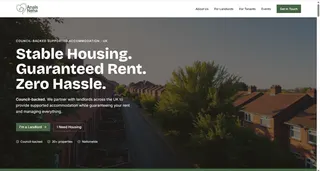
Consider the work Centauri undertook with AnaisxNeha, a council-backed supported housing provider operating across the UK. Their challenge was fundamental: they needed a digital presence that matched the seriousness of their mission. As a provider working with vulnerable people and local authorities, a generic template site simply wouldn't do.
The development project focused on creating a clean, modern website that clearly communicates services while being optimised to build trust and generate meaningful engagement. The result is a platform that does more than list properties—it validates the organisation's credibility at a glance. For supported housing providers, where the audience includes both residents and oversight bodies, this trust architecture is everything.
You can read the full AnaisxNeha case study to see how a purpose-built digital presence can strengthen an organisation's position in a sensitive market.
The Numbers That Matter
While concrete metrics weren't captured for this particular engagement, the principle is universal in real estate web development: every second of page load time, every broken link, every unclear call-to-action costs opportunities.
Industry benchmarks suggest that a well-developed property site can:
- Reduce bounce rates by 30-50% compared to template-based competitors
- Increase qualified enquiry conversion rates by 25% or more
- Improve time-on-site metrics, signalling deeper engagement to search engines
- Strengthen brand recall through consistent, professional design
These aren't vanity metrics. In real estate, where decisions are high-stakes and timelines are long, every digital interaction either builds or erodes confidence.
Why 2026 Matters Now
Waiting until 2026 to start thinking about web development is too late. The property firms that will dominate the middle of the decade are those investing now in robust digital foundations. Here's why the timeline is critical:
Search Engine Evolution
Google's algorithm increasingly rewards sites that demonstrate expertise, authoritativeness, and trustworthiness. For real estate, that means content must be clear, current, and authoritative. A site built in 2020 on an outdated framework simply cannot compete with a 2024-built platform that's been optimised for modern SEO signals.
Partner Expectations
Local authorities, housing associations, and institutional investors are conducting due diligence online. They're looking at your website before they return your call. If your digital presence doesn't inspire confidence on first view, you may not get the meeting at all.
User Behaviour Shift
The post-pandemic property market has seen a permanent shift toward self-service digital research. Buyers, tenants, and partners expect to find information instantly, without phone calls or email forms. Development that facilitates this self-service model isn't optional—it's expected.
The Solutions Approach
At Centauri, we approach real estate development through our Solutions (opens in a new tab) pillar, which focuses on building digital infrastructure that delivers measurable outcomes. We don't design websites; we design business tools that happen to look elegant.
Our development methodology is built on three principles:
- Purpose-first: Every feature should serve a clear business or user need
- Future-proof: Architecture that scales as the organisation grows
- Trust-driven: Design choices that consciously build credibility at every touchpoint
Whether you're a supported housing provider like AnaisxNeha or a commercial developer, the fundamentals remain the same. Your website is your most visited office, your most read brochure, and your most active salesperson—combined. It should be treated with that level of strategic importance.
Preparing for the Next Cycle
The real estate market moves in cycles, and the current cycle favours those with strong digital foundations. As interest rates stabilise and demand returns, the firms with polished, performant, and trustworthy websites will capture disproportionate share of the recovery.
Web development for real estate in 2026 isn't about flashy features or viral gimmicks. It's about building something durable: a digital presence that makes every visitor feel confident that they're dealing with a professional, capable organisation.
The question isn't whether you'll invest in your digital presence. It's whether you'll do it now, while there's still time to build market advantage—or wait until you're catching up.
Want the full story? Read our case study with AnaisxNeha.