Solutions
Real Estate Development Trends 2026: Why Trust and Transparency Are the New Currency
A new wave of real estate development trends is shifting the industry away from speculation and toward purpose-built, transparent models — and the numbers prove it works.
The Shift from Speculation to Substance
For years, real estate development has been driven by a familiar formula: acquire land, build units, and sell them as quickly as possible. But as we move into 2026, that model is showing cracks. Rising interest rates, shifting tenant expectations, and increased regulatory oversight are forcing developers to rethink their approach. The question is no longer simply how fast can we build? — it's how do we build something that lasts?
The answer, increasingly, lies in trust. Developers who prioritise long-term relationships over short-term gains are the ones seeing real, measurable results. And nowhere is this clearer than in the rise of models that combine guaranteed income with social purpose — turning real estate into a vehicle for stability rather than speculation.
Why Guaranteed Rent Is Reshaping the Landscape
One of the most striking real estate development trends of 2026 is the growing popularity of guaranteed-rent models. Landlords are tired of chasing tenants, dealing with void periods, and worrying about compliance. They want certainty. And developers who can offer that certainty — backed by real data and transparent operations — are quickly becoming the preferred partners for forward-thinking investors.
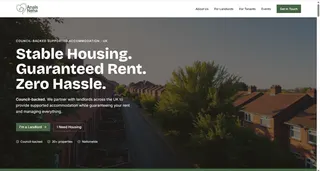
Consider the case of AnaisxNeha, a real estate developer that leases properties from landlords and houses council-backed tenants who need support. The model is elegant in its simplicity: guaranteed rent, weekly cleaning, full compliance management, and zero void periods. It's the kind of proposition that sounds almost too good to be true — until you see the numbers.
That's where our Solutions (opens in a new tab) team came in. We designed and built a multi-page marketing site that leads with the promise — stable housing, guaranteed rent, zero hassle — and then splits cleanly into two audience journeys: one for landlords and one for tenants. The proof is front and centre: over 30 properties showcased, council-backed tenancies, and long-term leases that provide both security and profitability.
The result is a live marketing site with six core pages and two distinct audience journeys, all built to demonstrate that this model isn't just a theory — it's already working.
The Data-Driven Developer: What Numbers Reveal About 2026's Market
The most successful real estate developers in 2026 won't be the ones with the biggest marketing budgets or the flashiest sales pitches. They'll be the ones who can point to concrete, verifiable results and say, "This works."
Data is the new differentiator. Developers who track void rates, tenant retention, compliance costs, and property performance are able to build trust with landlords who've been burned by empty promises before. And that trust translates directly into growth.
Our work with AnaisxNeha is a perfect example of how a developer can use a clear, data-backed message to attract partners and tenants alike. The marketing site we created doesn't just describe the model — it proves it. With 30+ properties shown and two clear audience paths, the site turns abstract promises into tangible evidence.
For developers looking to stay ahead of the curve, this is the playbook: lead with proof, not hype. Use your data to tell a story that resonates with landlords and tenants who are tired of uncertainty.
Brand Design as a Trust Amplifier
It's one thing to have a great real estate model. It's another thing entirely to communicate it effectively. As the industry evolves, brand design has become a critical tool for establishing credibility and cutting through the noise.
The old approach — a generic website with a "Contact Us" button — no longer cuts it. Tenants want to see that a property is safe, well-maintained, and professionally managed. Landlords want to know that their investment is protected. The brands that win in 2026 are the ones that make those assurances impossible to ignore.
Our Marketing (opens in a new tab) approach for AnaisxNeha was built around this principle. Every page, every call-to-action, every visual element was designed to reinforce the core message: low risk, high stability, and proven results. The clean, professional design communicates confidence without arrogance — exactly what landlords and tenants need to see.
That's not an accident. It's a deliberate strategy that aligns brand identity with market reality.
How Community-Focused Models Are Winning
Perhaps the most significant shift in real estate development trends heading into 2026 is a renewed focus on community. Developers who treat properties as isolated assets are losing ground to those who see them as part of a larger ecosystem.
AnaisxNeha's model is deeply rooted in community. By housing council-backed tenants — people who need support — and providing ongoing management including weekly cleaning and compliance oversight, the developer isn't just filling units. They're contributing to stable, healthier neighbourhoods. And landlords are responding because the model works.
This community-first mentality is gaining traction across the sector. Local councils, housing associations, and institutional investors are all increasingly drawn to developments that offer measurable social impact alongside financial returns. In a world where ESG criteria are no longer optional, developers who can prove their model delivers both are the ones who will secure the best partnerships.
The Future Belongs to Transparent Developers
As we look ahead to the rest of 2026, one thing is clear: the real estate developers who thrive will be the ones who embrace transparency, prove their results, and build trust at every turn.
The old playbook of hype and speculation is running out of road. In its place, a new generation of developers is showing that stability, community, and guaranteed outcomes aren't just buzzwords — they're a business model that works.
Whether you're a landlord looking for reliable income, a tenant seeking secure housing, or a developer exploring new approaches, the message is the same: the future of real estate is built on trust.
Want the full story? Read our case study with AnaisxNeha.