Marketing
30+ Properties, Zero Void Periods: Building Landlord Trust Through Development
In a market where trust is currency, real estate brands that combine strategic development with purposeful design are outperforming the competition — and one B2B leasing model shows exactly how.
The New Rules of Real Estate Branding
The real estate industry has long relied on location as its primary value proposition, but 2026 has brought a fundamental shift. Today's most successful brands aren't just selling square footage — they're selling certainty. Landlords want guaranteed income and zero hassle; tenants need stability and support. The brands that bridge this gap with clarity and digital presence are the ones winning market share.
This shift isn't about flashy redesigns. It's about aligning development strategy with audience psychology. When a real estate brand prioritises user experience, information architecture, and proof-driven storytelling, it transforms from a transactional business into a trusted partner. And that transformation happens through intentional development — not by accident.
Why Trust Has Become Real Estate's Most Valuable Asset
The post-pandemic rental market has reshaped expectations on both sides of the lease. Landlords who once accepted periodic vacancies now demand guaranteed returns. Tenants, particularly those in supported housing programmes, require wraparound services and long-term stability. This dual-pressure environment means real estate brands must communicate their value instantly — or lose the opportunity entirely.
Enter the Centauri Solutions (opens in a new tab) framework. By developing marketing sites that lead with proof over promises, real estate brands can cut through noise and build credibility from the first click. The difference between a site that converts and one that bounces often comes down to how quickly visitors can answer one question: "Does this work?"
Development That Delivers on Both Sides
Traditional real estate marketing sites try to please everyone and end up convincing no one. The most effective approach treats landlords and tenants as separate audiences with distinct journeys. This is where thoughtful development makes an measurable impact: when a single site can guide two different user types to the outcome they need, without either feeling like an afterthought.
The model works because it mirrors the real-world split. Landlords scrolling on mobile after work want numbers, guarantees, and proof. Tenants browsing in the evening want safety, support, and a clear path forward. When those are the same site — but structured differently — the brand signal becomes unmistakable: "We handle both sides, and we do it well."
Proof Points: The Numbers That Build Confidence
Real estate brands often struggle with a credibility gap. "Guaranteed rent" sounds like marketing spin until someone proves it. The strongest development strategies embed proof into the architecture itself — not tucked away on a separate "results" page, but woven into the flow decision paths.
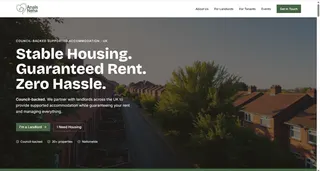
Consider a leasing model that manages 30+ properties across a portfolio, with zero void periods and council backing. When a site leads with that data upfront — rather than burying it in a testimonials page — the brand immediately communicates competence. The numbers do the talking, and the development prioritises them as the headline.
This is the difference between a site that describes a service and one that sells a system. The best real estate brands in 2026 are treating their websites as operational assets, not digital brochures. They're using development to mirror the efficiency they promise in their business model.
Information Architecture: The Foundation of Digital Trust
The biggest mistake real estate brands make is overcomplicating their navigation. When visitors arrive confused, they leave. A lean information architecture — six core pages, two clear audience journeys, and a direct path to action — reduces cognitive load and increases conversion.
This isn't minimalism for aesthetics. It's strategic simplification. Every page must answer three questions: "What do you offer?", "Do you serve people like me?", and "How do I get started?" When development strips away everything that doesn't serve those answers, the brand message becomes magnetic.
The Role of Marketing in Real Estate Development
While development builds the structure, Marketing (opens in a new tab) amplifies the message. Real estate brands that invest in content marketing, search optimisation, and audience targeting see compounding returns. A well-developed site is the foundation; a smart marketing strategy is the growth engine.
For real estate, this means creating content that speaks directly to landlord pain points (void periods, tenant management, compliance) and tenant needs (stability, support, fair terms). Marketing multiplies the impact of development by bringing the right visitors to a site that's already built to convert them.
Lessons from a Purpose-Built Model
One client in the supported housing space exemplifies how development can transform real estate branding. AnaisxNeha leases properties from landlords and houses council-backed tenants, managing everything from cleaning to compliance. The core promise — guaranteed rent, zero void periods, weekly maintenance — is straightforward once explained, but the company needed a digital presence that communicated that simplicity instantly.
Through a focused development engagement, Centauri designed a six-page marketing site with dual audience journeys. Landlords land on proof: 30+ properties, council backing, long-term leases. Tenants find safety: stable housing, support systems, clear terms. The site leads with the model's strength rather than its mechanics.
The results are measurable: a clean information architecture, two distinct user flows, and concrete data visible from the first scroll. The full case study is available on the Centauri site for deeper insight.
What Every Real Estate Brand Should Build Next
The bar for real estate development has risen. Generic templates and stock photography no longer suffice. In 2026, the brands that win are those who approach their digital presence with the same operational rigor they apply to their physical portfolios.
That means:
- Proof-first architecture: Lead every page with numbers and guarantees, not taglines.
- Dual-audience thinking: Treat landlords and tenants as separate users with distinct conversion paths.
- Lean navigation: Keep the core site under 10 pages, narrowing focus to what drives decisions.
- Data visualisation: Show vacancy rates, guarantee spans, and portfolio scale in human-readable form.
The Final Word
Real estate is a trust business. Every interaction either builds or erodes confidence. Development — when done with audience psychology, information architecture, and proof-based messaging — is the most powerful trust-building tool a brand can deploy. The brands that invest in it now will define the market for the next decade.
Want the full story? Read our case study with AnaisxNeha.